

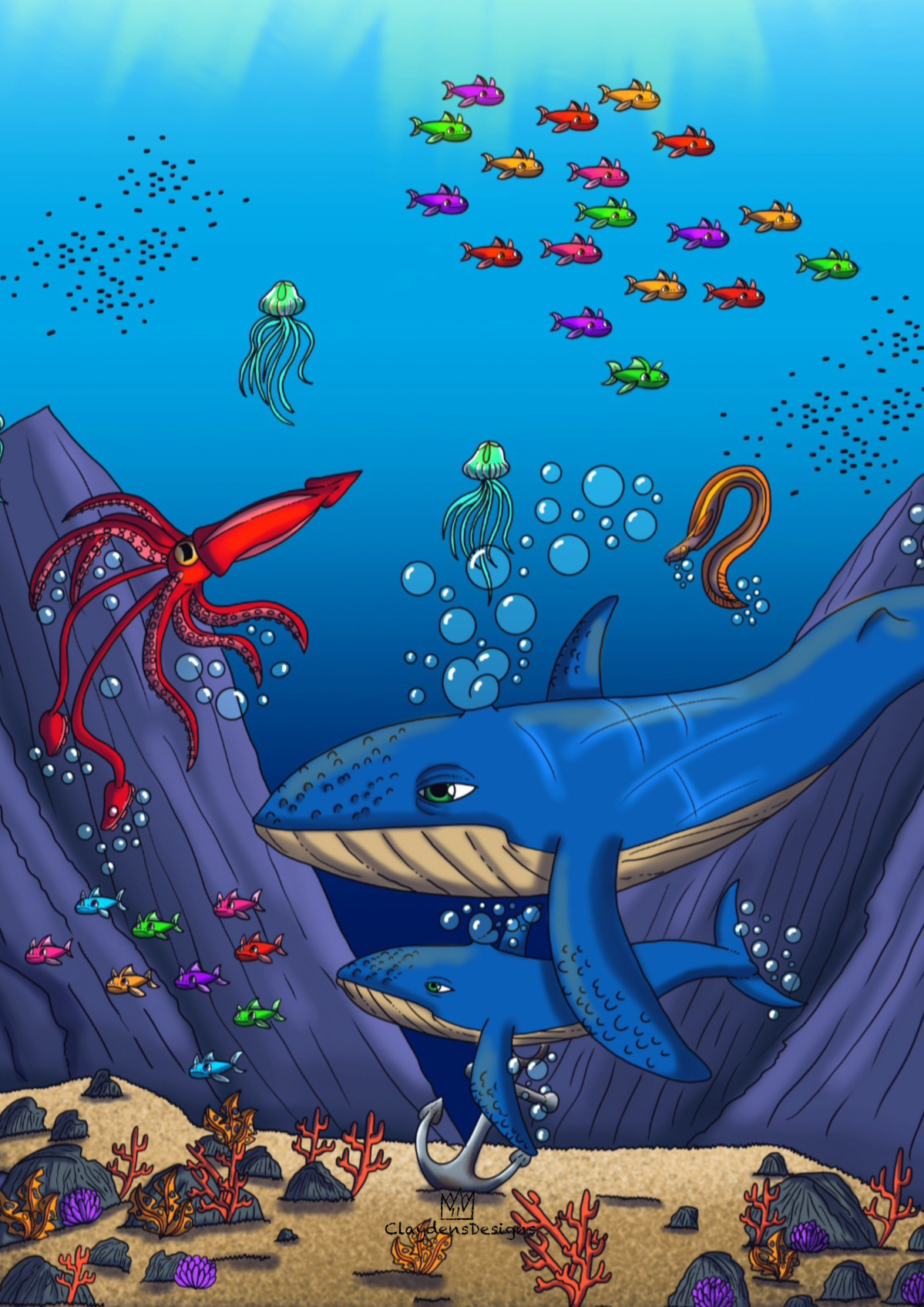
Artwork by Freya Kotter
By: Freya Kotter, 14, Austria
The ocean is a wonderful place. It is home to a huge number of species and it is crucial that we protect our oceans. If we don’t, it could lead to extinction of many species and creatures that we have not discovered yet, and cause an imbalance of the marine ecosystem. This would also affect us greatly as the ocean contributes to our lives as a whole by stabilising the water cycle and weather patterns, as well as giving us food.
Plastic waste is a major contributor to loss of life below water as well as life on land. Plastic may be cheap and easy to produce but it takes decades to centuries for it to decay. This has become a real concern. Only 9% of the world’s plastic is recycled (Geyer, Jambeck, and Law, 2017), 12 million tonnes of plastic is dumped into the ocean every year, 8 million pieces of plastic make their way to the ocean every day (Surfers Against Sewage, 2024). Scientists have also warned us that plastics in oceans will triple between 2015 to 2025 (Government Office for Science, 2018). This is a huge problem as this will cause a significant decline in marine life.
Plastic fishing nets are one of the biggest threats to the marine ecosystem. They are one of the main reasons that so many species die either because they get trapped or mistake it for food. Fishing nets also damage coral reefs and other habitats as they drift off and get caught easily. To protect the environment from these nets we could enforce a law to mark equipment, so if it gets lost and is found they can pay a penalty fee. However, to avoid all this from happening we need to take action and stop using as much plastic. There are already alternatives to plastics like biodegradable plastic made from natural substances like algae. Many conventional plastic wastes end up washing up on shore and pollute the soil, causing some plants to absorb microplastics, making them essentially 1% plastic!
Other threats to the ocean include overfishing and global warming. Overfishing is sometimes taken too far which can cause the food chain to become less stable and therefore the whole ecosystem suffers. Global warming is another major issue because it causes the oceans to rise and weather patterns to change drastically over a short period of time. This can cause flash floods and the oceans to become more vigorous and erode more land rapidly over a shorter time span. Global warming, plastic waste and overfishing all harm our oceans and present a huge threat to the health of our planet. I think we should try to change our perspective and minimise the impact of our behaviour on our earth.
References
Geyer, R., Jambeck, J. R., & Law, K. L. (2017). Production, use, and fate of all plastics ever made. Science Advances, 3(7), e1700782. https://doi.org/10.1126/sciadv.1700782
Government Office for Science. (2018). Foresight Future of the Sea A Report from the Government Chief Scientific Adviser. https://assets.publishing.service.gov.uk/media/5afab2f440f0b622e060e2b7/foresight-future-of-the-sea-report.pdf
Surfers Against Sewage. (2024). Plastic pollution: facts & figures. Surfers against Sewage. https://www.sas.org.uk/plastic-pollution/plastic-pollution-facts-figures/
 Harmony Online Journal - Youth Voices on Science, Law and Sustainability