What I Like the Most About Life on Land

By: Chama Ntabeni Chilubanama, 8, Zambia

As an 8-year-old boy in sunny Lusaka, Zambia, I like the fact that we normally have the perfect weather and we can take care of plants and animals. We can do more to make our environment clean and beautiful, and so we can remain healthy. They say, cleanliness is next to godliness and health!

I do not like it when I see litter thrown on the ground instead of the bins. It makes the surroundings dirty and unhealthy for all living things. I have a compost bin in the kitchen which I empty into the garden every morning. This is one way I want to help life on land. People should change and learn the benefits of recycling.

Right now, there is a drought in Zambia. What I mean by drought is there isn’t enough water because there isn’t enough rain, and people are suffering. People have been cutting down trees which are useful for making rain. We need to do something about the drought.

I like how we discover new places and how there are all sorts of animals and insects especially during the rainy season. I also like going to school and learning new things. I love animals, especially kittens and puppies. I also love to walk around in our garden to admire the different plants in all their shapes, sizes, colours and unique outlooks.

The plant I like the most is the Areca palm tree, because it is not too tall, it is just right and majestic along the swimming pool at home. I also like the Areca palm because it attracts beautiful bright coloured birds every now and again. I like the overhead view of the Areca palms when I go upstairs and I get a beautiful glimpse of all the bright and beautiful living creatures in my yard. I only muse to myself how awesome life on land is from a bird’s eye view. I wish I was a bird to see every living thing on earth. I love life on land!

Protecting our Fenlands: A Short History of East Anglia Biodiversity Ravages, Resistance and Rewilding

Artwork by: Nico Cordonier-Gehring

By: Nico Cordonier-Gehring, Canada/Germany/Switzerland/UK

Introduction

The cultural, economic, and political history of the Fenlands, including my Cambridgeshire home in East Anglia, offer an inspiring tale of biodiversity ravages, resistance and rewildings. Across nearly 1,500 square miles of southeastern Lincolnshire, most of Cambridgeshire including parts of historic Huntingdonshire, and the westernmost parts of Norfolk and Suffolk, the Fens lie inland of the Wash. I was raised in this region where my grandfather and ancestors made their homes, and it is beautiful with wide open skies, vast misty wetlands, unique and wonderful wildlife, and distinct local communities. Local communities here hold a rich history, interwoven with indigenous religious practices and a spirit of resistance against external forces and exploitation, dating back to the days of the Gyrwas (the Fenlanders, or Fennish commoners) under King Canute. The history of Fenlands peoples and nature is a story of resistance to the destruction of biodiversity lands and livelihoods, which continues to this day through the conservation, carbon sink, and rewilding projects of local communities, youth, historians and scientists, including from the University of Cambridge. 

Cultural history of environmental stewardship

The independence and cultural identity of local fenlands Peoples has always been specially connected to the stewardship of the land and waterways. As archaeological and anthropological evidence reveals, the beliefs of the original fenland peoples were marked by a profound respect for nature. A pantheon of spirits and deities were associated with the natural features of their environment. Water, in particular, held sacred significance due to its abundance and vital role in daily lives. The Fenlanders worshipped various water spirits, believed to inhabit the rivers, lakes, and marshes. These spirits were seen as both protectors and potential threats, necessitating rituals to appease them and ensure safe passage and bountiful fishing. 

Sacred sites include springs, wells, and groves, and many of these survive to this day, albeit overwritten or repurposed by Christian monasteries or churches. For example, the cathedral and monastery at Ely were built on historic pagan ritual sites. Over time, the imposition of Christianity transformed the religious landscape of the Fenlands. Many local practices were either absorbed into Christian rituals or suppressed, although traces of indigenous beliefs persisted within a Christian framework. For instance, sacred wells became associated with saints, like our Lady of Walsingham or the wells at Walsingham Abbey, and seasonal festivals with processions were adapted into Christian celebrations.

The distinct cultural identity and local knowledge of the Fenland peoples has played a crucial role in resistance against external forces, especially during periods of conquest. The encroachment of Roman, Saxon, and later Norman influences brought attempts to impose new government, laws, practices and administrative controls. However, the fenlanders fought back. Control and invasion was fiercely resisted by the locals, including Hereward the Wake, a local hero who led a rebellion against Norman rule in the 11th Century. His legacy symbolises the enduring spirit of resistance and the defence of local traditions, and inspires local youth, even to this day.

Political history of the Fenlands

The Fenland’s unique ecology and geography, with isolated island homes, floating reeds and shifting lakes and riverbeds, provided areas of retreat from enemies and allowed considerable independence in terms of religion and beliefs. And it is through the draining and destruction of these unique wetlands, threatening the wildlife and rich natural systems with destruction, that very nearly destroyed the Fenlands identity, culture and local livelihoods from the 1600s onwards. For centuries, lords and aristocrats advanced proposals to enclose the commons, then drain the Fens to access the naturally rich soil for farming. 

As one historical example, the Isle of Axholme wetlands commons were guaranteed by ancient treaties such as the 1359 Axholme Deed of John de Mowbray, which was kept a locked iron-bound chest in the parish church of Haxey under a stained-glass window of Sir John holding the accord. When Cornelius Vermuyden, a Dutch entrepreneur, sought to violate these rights with a company of ‘Adventurers’ (investors), over two thousand commoners resisted. In 1629, local women verbally distracted drainage workers, while men ambushed them, filling in the ditches, smashing tools, and even constructing mock gallows to loom over the diggers, making clear the consequences of continuing to break the Treaty of Axholme. According to government records of 1629, rather than justice, fen people faced penalties and harsh punishments for making their views heard, and refusing to support their own dispossession, including being beaten and jailed. However, they continued to resist, driving cattle through enclosures. 

Economic history of the Fenlands

Although local resistance was fierce, the adventurers and investors finally embarked on large-scale enclosure and drainage of the fens in the 1800s, using foreign workers, windmills and then steam pumps to pull the water away from the majority of the fens, filling in the common wetlands with private holdings and farms. A group of wealthy and powerful investors under the Earl of Bedford near Lincoln came together to canalise the fenlands rivers, undertaking massive earthworks, levelling and installing embankments and relief channels, and dredging operations to drain and privatise the collective wetlands areas. Unfortunately, their ‘Bedford Corporation’ also destroyed the local habitat of wildlife and ecosystems, taking away the natural resources and livelihoods of many local fishing and wildcrafting communities. Employing constables and guards, and hiring labourers from outside the area, they built pumps and small channels to disrupt and eliminate the water so that just the fertile mud was left. 

These exploitative projects faced heavy opposition from the local villages and fenlands peoples, who worried about their access to eels, fish, waterfowl and game. Local groups organised to burn down pumping stations and refill ditches overnight, they even hosted cultural events and festivals to disguise attempts to disrupt the dredging operations. The fenlands Peoples resisted on all levels, even taking petitions to the Privy Council and to the King in their defence. While the draining eventually succeeded, and vast farmlands were planted, East Anglia is already facing the results of that folly, as the rivers and canals silt up, and the flooding, with only scattered remnants of peat bogs and washes to absorb the rains, becomes worse every year, drowning villages and towns. 

Fenlands today: Taking action for conservation 

Still, the history of our fens is not over. Local peoples, joined by nature advocates. In the 2000s, local and national governments are working to re-wild areas of the Fenlands, reclaiming, and restoring them in order to prevent flooding and natural disasters in response to climate change and biodiversity loss. The Wicken Fen Vision 2030 plans to nearly quadruple the protected wetlands as a carbon sink and a local biodiversity haven. At the Great Fen, a vast fenland landscape between Peterborough and Huntingdon, as part of two National Nature Reserves, they are undertaking one of largest restoration projects ever for Europe, as landscapes are being restored and transformed for the benefit of both wildlife and people. With the addition of 120 hectares by rewilding Speechly’s Farm in 2023, completes a massive fenland jigsaw, reversing the harmful effects of those drainages from the 1600s to the 1850s, and creating a continuous corridor of natural wetlands between Woodwalton Fen and Holme. 

Conclusion

In conclusion, the story of biodiversity resistance and rewilding in the Fenlands highlights the deep connection between a People and the environment. Our Fenland Peoples’ ability to maintain cultural identity and resist external pressures underscores the powerful role of belief systems in shaping and preserving community cohesion. As we explore the history of the Fenlands, we can all learn a deeper appreciation for the resilience and creativity of these communities, and their continued attempts to find a balance between nature and livelihoods, one that respects and restores the local environment and its unique culture.

Bibliography 

Ash, Eric H. The Draining of the Fens: Projectors, Popular Politics, and State Building in Early 

Modern England. Johns Hopkins Studies in the History of Technology. Baltimore (Maryland): Johns Hopkins university press, 2017.

Boyce, James. Imperial Mud: The Fight for the Fens. London: Icon, 2020.

Pryor, Francis. The Fens: Discovering England’s Ancient Depths. London: Apollo, 2020.

Sly, Rex. From Punt to Plough: A History of the Fens. Reprinted. Stroud: Sutton Publ, 2003.

Other Resources Used:

JISC Archives Hub (online: www.archiveshub.jisc.ac.uk, last accessed 21 June 2024)

The Ouse Washes (online: www.ousewashes.info, last accessed 21 June 2024)

Literary Norfolk (online: www.literarynorfolk.co.uk, last accessed 21 June 2024)

Wicken Fen (online: www.nationaltrust.org.uk, last accessed 21 June 2024)

The Great Fen (online: www.greatfen.org.uk, last accessed 21 June 2024) 

Drawing for Wildlife

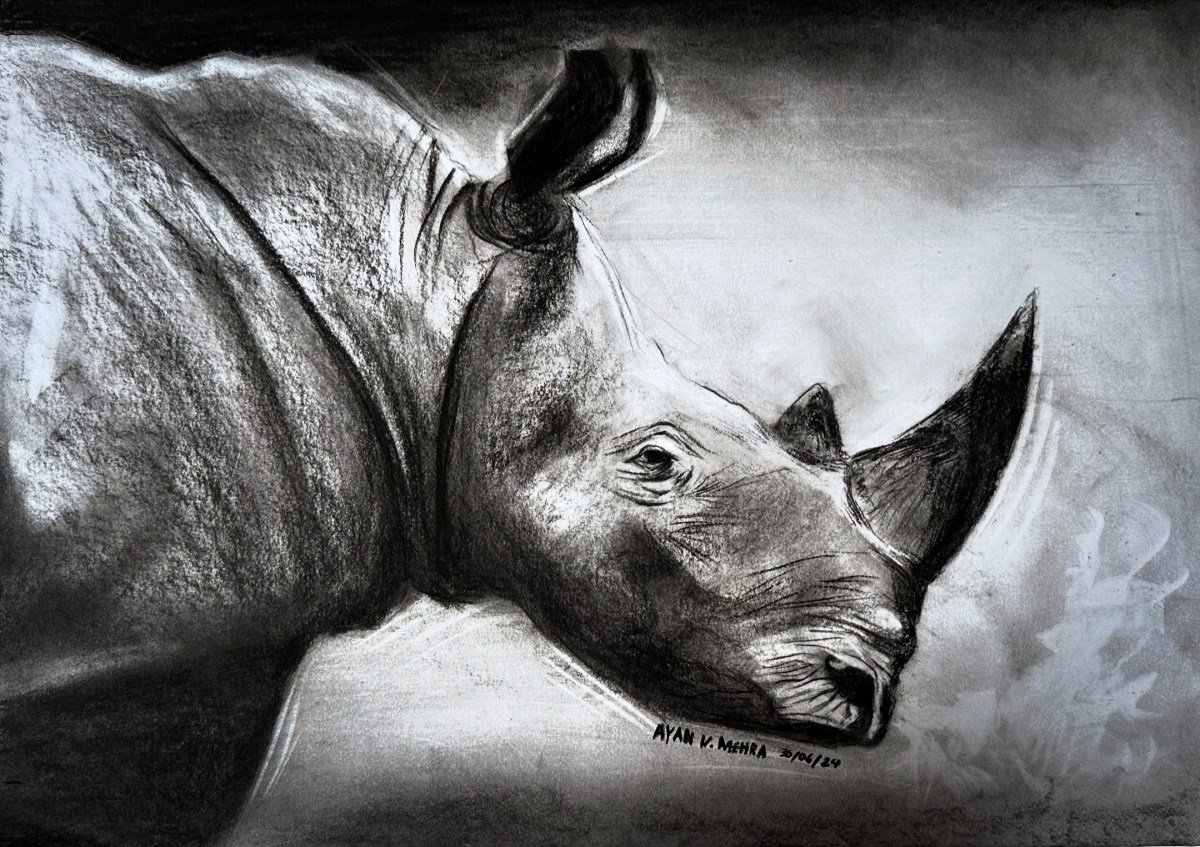
Drawing by Ayan Kamath Mehra

By: Ayan Kamath Mehra, India/Singapore

Qualia – coined by philosopher C. I. Lewis – refers to ‘instances of subjective, conscious experience’. For example, running your fingers through cold water, the experience of seeing the colour purple, and the struggle of lifting a new PR (personal record in lifting). These moments cannot be shared. Human language fails to transfer experiences from one person to another. No matter how many words are used in just the right way, it is impossible to explain the colour purple to a person born blind. Qualia cannot be shared.

However, I think art comes very close. While it may not transmit the exact experience, art can move an audience to feel the same way about said experience. This is why, I think, it is one of the most powerful tools for wildlife conservation. Art can make people care about the cause, appreciate the sentience of animals, and instil a passion to fight cruelty.

Incensed by the plight of rhinos brutally slaughtered for their horns; at the age of eleven, I decided to combine my passions for art and wildlife to raise awareness and funding for endangered species. I created savewildlife.art: a platform that celebrates animals through art and storytelling. In five years, savewildlife.art has raised funds to adopt 24 endangered animals around the globe, but perhaps more importantly has created awareness and ambassadors for wildlife conservation among the many people who have engaged with the art and stories on the platform.

Most recently, savewildlife.art partnered with Drawing for the Planet to create The Tiger’s Forest – an art workshop that goes to schools across India, Singapore, the UK, and the US, educating and inspiring children about our shared natural wealth in tigers and the animals that live in their ecosystems. By reaching thousands of children with art workshops we hope to evoke feeling and action, creating the next generation of wildlife warriors to nurture our planet.

Acknowledging Land and Life

By: Acacia Leonor Greenidge, 11, Canada/Trinidad&Tobago

I have a question for you. And I have an idea too.


I love the lake. It’s stunningly beautiful here at Sauble Beach, and the water shimmers in the sunlight. The waves amaze, and the sunsets seem unreal, just like when you stop using the computer and it changes to those breathtaking photos. The black silhouettes at sunset are so cool that you don’t have to be a professional photographer to take awesome photos. The trees and forests on the way to Carson’s Camp are as stunning as the stars and constellations, which you can see very well here.

I love the lake. I love the sunsets, the trees, and the stars. My question is: why can’t we see stars like this in the city?


And can we make good decisions about our future when we can’t see the stars at night? Here you can even see the satellites in the sky. Why can’t I see stars in the city every night? How can we make good decisions about nature from cities where we stay inside all day? At Carson’s Camp, the total minutes we spend inside must add up to about one hour. No one stays inside too long on purpose, except to sleep, rest or avoid the rain.


And my idea? Well, the breeze and the trees here are so inviting that people barely use their cars. Could the way to save and share life on land be to spend more time around lakes, sunsets, stars and trees, and not be so busy that we ignore their beauty?

The Buzzes Behind Biodiversity: The Often Overlooked Role of Insects

Artwork by Varvara Tretiakova

By: Raiyan Bakshi, 17, US

Insects… Pesky rashes, annoying buzz, disease vectors, overall nuisance. We usually don’t think of their tireless pollination, waste decomposition, and many other natural processes they facilitate.

The truth is insects, as pesky as they may be, are crucial for life on earth. We see them in everyday products from honey to silk. The health of our soil and food is heavily influenced by insects. They decompose organic matter and recycle these nutrients back into our soil, stimulating the nutrient rich crops we end up eating. While many think of insects as the pest, many of them like ladybugs, spiders and dragonflies, control pest populations, which also reduce the need for chemical pesticides. Furthermore, our ecosystems rely on them as a means of seed dispersal, pollination, or promoting biodiversity by being the primary food source for smaller animals.

Unfortunately, their survival, along with the benefits the Earth enjoys, are in danger. Intensive pesticide use in modern agriculture often stimulates too strong of a reaction for the natural balance of the ecosystem, not only wiping insect populations, but hurting the food web. Habit loss from excess urbanization and deforestation generally causes losses of biodiversity, but with insects it often has a compounding effect with many of their dependent species also hurt. Changes in climates and extreme weather patterns disrupts usual insect life cycle behaviours with crop flowering, diminishing their pollination rates.

These problems have no easy fix, but addressing them is necessary in our fight to protect our planet. Policies for sustainable agriculture and pesticide use, controlled land development, and dependency away from fossil fuels contributing to global warming are all steps in the right direction.

As we commit ourselves to saving our life on earth’s land, let’s not forget about our tiny allies promoting nature in our land, air and seas.

From Soil to Sky: The Rich Tapestry of Life on Land

Artwork by Aida Mugutdinova

By: Mahesh Mandavelli, 15, India/Poland

Did you know that the Earth experienced its warmest day in recorded history on July 22, 2024 with a global average temperature of 17.16°C (Copernicus Climate Change, 2024, July 25)? Annually, around one-third of the Earth’s geographical area is at risk of desertification (“The World Counts”, 2023). Furthermore, the populations of several species have experienced a significant decrease, with an average reduction of 69% since 1970 (Pullen, 2022, October 13). These concerning figures highlight the immediate necessity for taking action.

Forests, which occupy 30% of the Earth’s surface (Ritchie, 2021), have a vital function in mitigating climate change, offering sustenance and refuge, and  sustaining a wide range of ecosystems and indigenous communities. Approximately 1.6 billion individuals depend on forests for their means of subsistence (Chao, 2012). Although there is growing global recognition of land degradation, invasive species, poaching, and wildlife trafficking, these dangers persist and pose ongoing risks to the conservation of  biodiversity and the habitats of indigenous groups. If we do not take fast and coordinated action, there is a high probability that one million plant and animal species will become extinct. 

Land encompasses several elements such as trees, houses, humans, animals, climate, and more. In general, humans bring about alterations. Regardless of the circumstances,  global warming will persist until humans take action to alter the climate. In order to initiate a transformation, it is imperative that we address the issue of desertification and deforestation, starting with the soil. The second factor to consider is the climate. Upon cultivating the plants, we can observe the alteration in temperature. Once soil and climate conditions are established, human existence becomes intricately linked to the availability and quality of air and water. By refraining from polluting nature with substances such as plastic and petroleum gas, we can have tranquil lives. It is important to acknowledge that we are all interconnected in the intricate network of life, and our activities have an impact on every individual and element on Earth. The fact that everything is connected emphasizes our shared duty to safeguard our world. 

Each individual has the ability to contribute towards its accomplishment. Conduct  research on companies that implement sustainable packaging and other  environmentally conscious activities. Request the cooperation of your acquaintances  and relatives to initiate the practice of recycling and motivate all individuals within your  social circle to bring their personal bags when shopping at grocery stores. Utilize a  collection of durable utensils, drinking tubes, and a container for liquids such as a water  bottle or canteen. You have the ability to express your endorsement to both your local  and federal authorities. You can also educate others in your community on the ways in  which deforestation and land degradation contribute to climate change and the loss of  plant and wildlife diversity. Coordinate the establishment of a communal horticultural space or an arboreal planting occasion and emphasize the significance of engaging in  planting activities. It is important to bear in mind that each of us possesses the ability to  have a significant impact. The choices you make have significance and have the  potential to bring about change.

References

Chao, S. (2012). Forest peoples: numbers across the world(Vol. 10, p. 2017). Moreton-in-Marsh, UK: Forest Peoples Programme.

Copernicus Climate Change. (2024, July 25). New record daily global average temperature reached in July 2024 . Climate.copernicus.eu. https://climate.copernicus.eu/new-record-daily-global-average-temperature-reached-july-2024

Pullen, A. (2022, October 13). WWF Living Planet Report: Devastating 69% drop in wildlife populations since 1970. Www.wwf.eu. https://www.wwf.eu/?7780966/WWF-Living-Planet-Report-Devastating-69-drop-in-wildlife-populations-since-1970

Ritchie, H. (2021). Forest area. Our World in Data. https://ourworldindata.org/forest-area

The World Counts. (2023). Www.theworldcounts.com. https://www.theworldcounts.com/challenges/planet-earth/forests-and-deserts/global-land-degradation

Stop the Cause, Be the Change.

Photograph by Deborah Thankam Ciju

By: Deborah Thankam Ciju, 14, India

Ever since I was a child, I’ve been taught that littering is a major no-no. But when I look around my city, all I see are heaps and piles of trash everywhere. Witnessing the devastating floods and landslides in Wayanad, Kerala, where waste-clogged rivers and hundreds of lives are at risk, deepened my resolve. That’s why I made a promise to nature, I vowed to volunteer for clean-ups and reforestation efforts, determined to play my part in restoring and healing our land.

Life on land is a rich tapestry of ecosystems, where diverse species coexist and interact in a web of life. From lush forests and sprawling grasslands to arid deserts and towering mountains, terrestrial habitats support a vast array of organisms, each playing a unique role in maintaining the balance of nature.


Sustainable Development Goal 15 (SDG 15) focuses on “Life on Land,” aiming to protect, restore, and promote sustainable use of terrestrial ecosystems. It addresses crucial aspects like managing forests, combating desertification, halting and reversing land degradation, and stopping biodiversity loss. Forests cover about 30% of the Earth’s land area, yet they are under constant threat from deforestation, which has severe consequences for the environment and climate.


Implementing SDG 15 begins with YOU! Start raising awareness about the importance of protecting terrestrial ecosystems. We as a community can participate in tree planting, support sustainable farming practices, and reduce deforestation by opting for responsibly sourced products. With wildfires, illegal logging, and other human-related causes of the destruction of land, we can put an end to this endless ending of misfortunes. Let history stop repeating itself and together we can stop the cause and become the change!

Take Care of Our Forests

Artwork by Lasya Hota

By: Sydnee Nisyok

Being taught that our lands are sacred, and everything living on our lands is to only be taken as needed and necessary is difficult to comprehend when our land continues to be logged. Living in a remote Indigenous community it is noticeable when we have areas of our land being logged and the lasting impacts for my generation and the generations coming after mine. The loss of forests causes climate change to get worse, the trees are important to create sustainability and battle climate change.


Deforestation is also ruining habitats and homes for animals and living creatures of many different species. Forests are filled with food and resources that people and animals need to live good long lives. Since my ancestors have lived here the forest has provided for us by giving us food, water and shelter and it’s time we take care of the forest too or we will be left with nothing. It has been noticeable that we are having less and less food to harvest and provide for our people and communities.


This is happening for different reasons, one being big companies are chopping down forests for more space for the people in the cities to have bigger buildings. Secondly, the legal and illegal logging for resources such as wood and fuel. Thirdly, wild forest fires due to global warming or human causes are affecting the number of trees that are destroyed worldwide. Finally, they are also taking down forests for lumber for their own use or manufacturing like paper, furniture, or even fuel for cooking and heating. When trees are gone, we do not have them to absorb the greenhouse gases that cause global warming, and when they are cut the release these gases back into the atmosphere.


We all have a responsibility to help our forests. Indigenous communities that may not have the resources that big cities do can still do their part to create change. We can help fix this by using the three “R”s, reduce reuse and recycle. Other little ways to help are by going paperless, supporting smart and responsible companies. When you buy stuff only get the things you need or things with less packaging. You can donate to organizations that go against deforestation, either your time or financially. You can plant trees and help restore the already damaged and logged forests. The biggest thing in my opinion that you can do is educate yourself and others so that more people know what is going on and how to help. We need our forests now more than ever so let’s act now. Be kind and take care of the forests.

Mother Earth, Her Ecosystems, Man and Woman!

Photo by Aasvi Kedia

By Wezi Emmanuel Chilubanama, Zambia

Sustainable Development Goal 15 is a very important goal because it is about me, the next person, and the other and the entire ecosystem of the world. Life on land is not just for the human race, but the whole ecosystem around us, and we are only but a part of it. This applies to both plant and animal life. If anything, most animals, including human beings, are interdependent. Let’s see how this happens in at least two ways.

First, ecosystem members depend on each other for food. Animals including man and woman are consumers of plants and decomposing animal carcasses provide nutrients for plants. This interdependency is required to sustain ecosystems and life on earth. Secondly, procreation is enabled through ecosystem interdependence. For example, most seeds are dispersed through animals. Seed dispersal and pollination are crucial steps in the reproductive cycle of plants, and are facilitated by animals, including humans. 

As humans make more space for businesses, agriculture or housing, trees are cut down. Now don’t just think of it as deforestation but as displacement of wildlife. Humans are not only disturbing forest wildlife, but are also cutting down trees that might not be replanted! If man and woman keep doing this, we might as well learn how to breathe in carbon dioxide! How about we share living places with plant life instead?

With this information in mind, we must not only appreciate life on land but also take care of Mother Earth and her endowments. Man and woman must make some areas completely off limits in order to keep as much fauna and flora safe. From the softness of the grass to the chilling shade of a large tree, animals find some comfort. Man and woman may get this similar feeling from the roofs over their heads or soft rugs; man and woman must also think of the creatures that can’t get this same luxury due to their actions.

In conclusion, the world houses beautiful sites to see, not man-made but naturally made. We can’t continue to take it for granted, so let man and woman fight to keep Mother Earth and her ecosystems safe, as well as grow and develop along with her.

The Silent Whispers of Mother Nature: From desolation to hope

Artwork by Kelvin Li

By: Varnessa Kayen Varlyngton, Nigeria

Growing up in the city once known as “The Garden City of Nigeria,” I developed a deep love for nature. However, my idyllic perception of my surroundings was shattered when I witnessed the harsh environmental reality faced by the people of Rivers State.


The city, once a vibrant oasis teeming with life and lush greenery, now stands as a desolate wasteland stripped of its trees. Human activities more rampant than ever have ravaged our once-beautiful landscape. The absence of trees resulted in heat waves that mercilessly tormented us before the rainy season, making it nearly impossible to focus in our classrooms. Children, including my younger sister, fell victim to severe heat rashes and global warming became more evident, a grim reminder of the consequences of environmental degradation. Deforestation was the first sign of environmental degradation in my city that I had ever studied and witnessed.

I began to wonder why humans would be so cruel. Nature has been so kind to us, from the beautiful trees that provide us with oxygen and the little animals that kept us company. Everyone had once praised this land for being so beautiful and great but what is it now? Desertification might be knocking at the door in a few years’ time. Realising that what could be the apocalypse of the earth was us humans, a fire within me had been ignited. I thought to myself: “Nature has been kind to us so let us reciprocate that love”. I began to find creative ways to make a change and say no to deforestation. SDG 15: Life On Land needed to be protected.

To achieve social justice we must achieve environmental justice and this is my message to the world. This was the reason why I decided to start Egalitarianism for Earth, recognizing the interconnectedness of all species, ecosystems, and the Earth, and seeking to ensure ecological equality, environmental justice, and sustainable coexistence. In this relentless pursuit of environmental justice, I launched the Children4Climate Initiative with a movement known as TreeTrek, a bold endeavour aimed at restoring the once-glorious Garden City of Nigeria. Starting the Children4Climate Initiative and the movement is my way of raising awareness and taking actions especially in a world where Gen Alpha aren’t involved in trivial matters that relate sustainability.

From hosting workshops at the local schools, using animations to amplify mother nature’s cry, writing and reporting these environment – related Indigenous stories, creating petitions and writing an open letter to the federal government of Nigeria demanding for climate education, I believe that I am changing that narrative as a young Gen Alpha leader and playing my role in the cycle of life.

We should all understand that life on land is desperately crying for our help….If you can’t hear it I urge you to go back to a quiet place and look at the world around you and see how she’s slowly fading away. However, if everyone eagerly works together to protect Life on Land and take climate actions,we secure a future for all. One where biodiversity thrives and sustainability is at its
peak. Together we can make a difference!