
Drawing for Wildlife

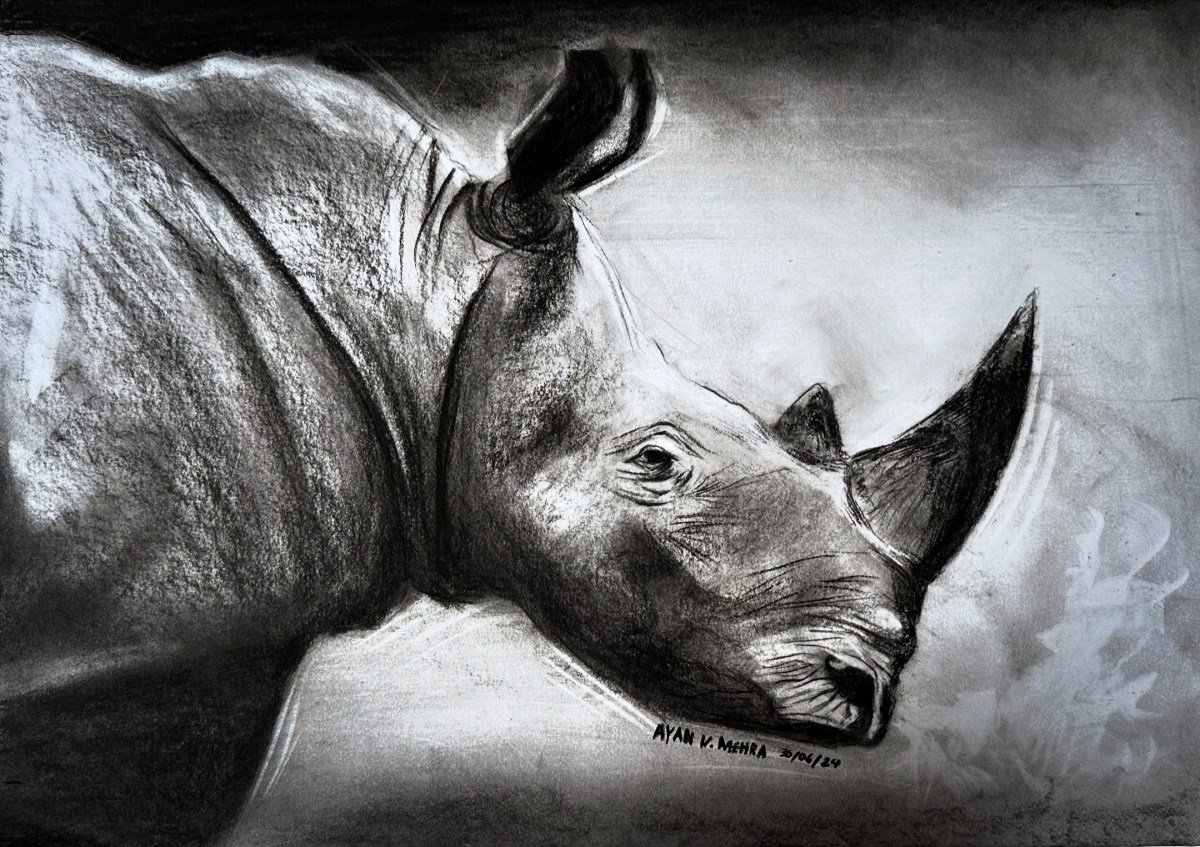
Drawing by Ayan Kamath Mehra

By: Ayan Kamath Mehra, India/Singapore

Qualia – coined by philosopher C. I. Lewis – refers to ‘instances of subjective, conscious experience’. For example, running your fingers through cold water, the experience of seeing the colour purple, and the struggle of lifting a new PR (personal record in lifting). These moments cannot be shared. Human language fails to transfer experiences from one person to another. No matter how many words are used in just the right way, it is impossible to explain the colour purple to a person born blind. Qualia cannot be shared.

However, I think art comes very close. While it may not transmit the exact experience, art can move an audience to feel the same way about said experience. This is why, I think, it is one of the most powerful tools for wildlife conservation. Art can make people care about the cause, appreciate the sentience of animals, and instil a passion to fight cruelty.

Incensed by the plight of rhinos brutally slaughtered for their horns; at the age of eleven, I decided to combine my passions for art and wildlife to raise awareness and funding for endangered species. I created savewildlife.art: a platform that celebrates animals through art and storytelling. In five years, savewildlife.art has raised funds to adopt 24 endangered animals around the globe, but perhaps more importantly has created awareness and ambassadors for wildlife conservation among the many people who have engaged with the art and stories on the platform.

Most recently, savewildlife.art partnered with Drawing for the Planet to create The Tiger’s Forest – an art workshop that goes to schools across India, Singapore, the UK, and the US, educating and inspiring children about our shared natural wealth in tigers and the animals that live in their ecosystems. By reaching thousands of children with art workshops we hope to evoke feeling and action, creating the next generation of wildlife warriors to nurture our planet.

Whispers of Giants: Adventure in the Ningaloo Reef

By: Ryan Hill, Canada

It was 6:00 a.m. when I was woken up by a beautiful bird song. I quickly jumped out of bed to look out my window to see if I could catch a glimpse of the bird with the enchanting call. To my eyes’ amazement I saw three birds with an array of colours. I learned that they were the awe-inspiring Rainbow Lorikeets. I knew today was going to be a magical day when I had the pleasure of witnessing one of Australia’s incredible animals. It was now time for me to get ready for a very special wildlife adventure.

In the Ningaloo Reef’s crystal clear waters swims a majestic creature. It has been on earth for over 65 million years. The Whale Shark (Rhincodon Typus), often referred to as “the sea puppies of the ocean”, have sadly become an endangered species. Overfishing, bycatch, vessel strikes, targeted fisheries and unsustainable tourism, have decreased their population significantly. The Whale part of its name demonstrates its enormous size and the Shark part of its name indicates that it is a fish. 

I had always dreamt about swimming with the Whale Sharks and I was fortunate enough to be able to swim with these gentle giants, with an ECO Certified, EcoStar accredited tour company. It was a beautiful blue sky with the sun shining a brilliant golden yellow on the palm trees. As the bus pulled up to take me to the boat, I couldn’t help but do a little happy dance in anticipation of what I knew would be an unforgettable day. I eagerly hopped on the small boat that was waiting for me at the dock, which took me to the main boat.

I was so pumped and excited when I finally stepped on to the tour boat. I quickly put on my wetsuit and snorkeling gear, as we drove to the middle of the oceans Ningaloo Reef. The boat slowed down and finally came to a stop, which meant a Whale Shark had been spotted. I jumped in to the water and instantly felt at home and in absolute peace. I put my face in the water and looked down, when I saw this gigantic, breathtaking, adorable, magical Whale Shark. Its gentle eyes looked at me as I swam beside it, as it calmly and slowly swam along its path. Its skin was smooth and shiny and its elegant design of polkadots were mesmerizing. I was so grateful that this beautiful wild animal let me swim with them and be a small part of their day. I knew that night that I would have amazing dreams about the magic that I witnessed and experienced and that it truly was one of the best days of my life.

I learned during my day on the boat that we can do something to help save the Whale Sharks. By respecting the ocean, reducing unsustainable seafood consumption, protecting Whale Shark habitats, discouraging Shark finning and supporting research and conservation groups, we can all help in keeping these amazing animals in our oceans for a very long time.

Mother Earth, Her Ecosystems, Man and Woman!

Photo by Aasvi Kedia

By Wezi Emmanuel Chilubanama, Zambia

Sustainable Development Goal 15 is a very important goal because it is about me, the next person, and the other and the entire ecosystem of the world. Life on land is not just for the human race, but the whole ecosystem around us, and we are only but a part of it. This applies to both plant and animal life. If anything, most animals, including human beings, are interdependent. Let’s see how this happens in at least two ways.

First, ecosystem members depend on each other for food. Animals including man and woman are consumers of plants and decomposing animal carcasses provide nutrients for plants. This interdependency is required to sustain ecosystems and life on earth. Secondly, procreation is enabled through ecosystem interdependence. For example, most seeds are dispersed through animals. Seed dispersal and pollination are crucial steps in the reproductive cycle of plants, and are facilitated by animals, including humans. 

As humans make more space for businesses, agriculture or housing, trees are cut down. Now don’t just think of it as deforestation but as displacement of wildlife. Humans are not only disturbing forest wildlife, but are also cutting down trees that might not be replanted! If man and woman keep doing this, we might as well learn how to breathe in carbon dioxide! How about we share living places with plant life instead?

With this information in mind, we must not only appreciate life on land but also take care of Mother Earth and her endowments. Man and woman must make some areas completely off limits in order to keep as much fauna and flora safe. From the softness of the grass to the chilling shade of a large tree, animals find some comfort. Man and woman may get this similar feeling from the roofs over their heads or soft rugs; man and woman must also think of the creatures that can’t get this same luxury due to their actions.

In conclusion, the world houses beautiful sites to see, not man-made but naturally made. We can’t continue to take it for granted, so let man and woman fight to keep Mother Earth and her ecosystems safe, as well as grow and develop along with her.

T is for Tiger

Artwork by Ayan Kamath Mehra

By: Anisa Daniel-Oniko, Nigeria/UAE

The other day, my family and I were playing a game called Name-Place-Animal-Thing, which works quite simply. You work through the alphabet, naming one of the aforementioned for each letter you land on. Somewhere around the T, we turned reflective.

“You know,” my mother said. “If we don’t work very hard, children will be born that will never connect the letter T to the tiger.” It is a sad reality.  So many species have already been spun into myths and memories, and if we don’t devote ourselves to eradicating the cycle, it will continue. But just how does that cycle begin?

Well, it is common knowledge that certain animals are poached for body parts and products (such as ivory, or shark fin soup). However, even if you don’t count illegal trade, hunting and harvesting have decimated the numbers of several species, blotting out some entirely (National Research Council (US), 1995). This, for example, was the fate of the passenger pigeon—a bird that abounded in American airspace during the 1800s. The ease of hunting the birds dwindled their numbers to nothing—the very last one, Martha, died in captivity in 1914 (National Museum of Natural History, 2019).

Then there is the matter of habitat. Climate change aside, anytime humans expand territory, the ecosystem suffers dire losses. Animals who previously inhabited the lands and seas—such as the dodo, or the Okinawa dugong (Koja, 2024)—are felled by civilization, new cohabitants, or disease. Humans and other species don’t live well together—we hunt or hinder each other often, stealing livelihoods. Like fitting a square peg into a round hole, urbanisation and urban sprawl cannot be done without destruction.

That is how extinction happens, and already the tigers have joined the ranks of the 45,300 IUCN-indexed species threatened by it (IUCN, 2024). Three tiger species are already extinct, and double that are currently endangered (McGonagle, 2024). But the conservation battle isn’t one without hope. In Bhutan this year, after a yearlong research expedition,131 Bengal tigers were discovered, 27% more than in 2015 (United Nations Environmental Programme, 2024). This spike was brought on by the tireless efforts of conservationists in the region and proves to us something vital. It is possible to turn back the tide on the damage done to the environment, and perhaps children will still grow up remembering that T is for the big cat with stripes. 

References

IUCN. (2023). The IUCN Red List of Threatened Species. IUCN Red List of Threatened Species; IUCN. https://www.iucnredlist.org

Koja, K. (2024, June 3). No dugongs found near Marine base on Okinawa after 3-year search, officials say. Stars and Stripes. https://www.stripes.com/branches/marine_corps/2024-06-03/dugong-marine-corps-runway-okinawa-14064158.html

McGonagle, J. (2023, November 28). Tiger Subspecies: Six Surviving- Three Extinct. The Tiniest Tiger. https://conservationcubclub.com/tiger-subspecies-six-surviving-three-extinct/

National Museum of Natural History. (2019). Extinction Over Time | Smithsonian National Museum of Natural History. Smithsonian. https://naturalhistory.si.edu/education/teaching-resources/paleontology/extinction-over-time

National Research Council (US). (2016). Species Extinctions. Nih.gov; National Academies Press (US). https://www.ncbi.nlm.nih.gov/books/NBK232371/

United Nations Environment Programme. (2024, January 19). In Bhutan, the endangered Bengal tiger is making a comeback. UNEP. https://www.unep.org/news-and-stories/story/bhutan-endangered-bengal-tiger-making-comeback